

I’ve been sharing a few carefully selected links on my Venn Factory LinkedIn page every month for a while now. With 2025 in the rear-view mirror, I thought it might be a useful exercise to cast an eye over the last few batches and see what story they tell now. Think of this exercise as “reverse predictions.”
🏠 September: assessing the health of our foundations
This month provided a bit of hope inside a “warning sandwich.” The item I’ve had the most conversations about in the intervening months was the third piece from Ross Haleliuk, connecting it to the chaos of the identity standards landscape and the continuing struggle to find market use cases for certain protocol stacks.
⚠️ AI web crawlers are destroying websites in their never-ending hunger for any and all content
We’ve all heard about the risk — or reality — of a “dead Internet,” where AI-generated content simply gets recycled into new model training. This piece explores the mounting pressure AI crawling puts on the already shrinking “open Web,” as more content shifts into identity-walled gardens.
“Yes, of course, we can try to fend them off with logins, paywalls, CAPTCHA challenges, and sophisticated anti-bot technologies. You know one thing AI is good at? It's getting around those walls.”
📈 Are Cyber Defenders Winning?
Unlike a soccer match, cyberspace offers no final whistle. This article digs into how we might measure whether defenders are gaining an edge in what feels like an endless, invisible contest.
“There is sufficient data across these indicators to point to a far more optimistic assessment than suggested by dystopian headlines.”
⚠️ In security, not every industry problem is a business problem
In digital identity, open standards are often the solutions to “industry problems.” Ross Haleliuk makes the case that industry-wide problems are tougher to tackle than business problems — raising the question: Are we focusing on the right ones at the right time?
“Many people with great ideas about how to improve security would be way happier championing a new standard, building a non-profit initiative, or an open source project.”
⚖️ October: hunting for accountability
This was an active theme all last year given the move to AI agents, and it’s still not that close to being solved. Who acts? Who benefits? Who is liable? And how do we preserve trust when agency is distributed?
🤥 Unpacking Sentiment and Emotional Manipulation in Relational AI
Kay Stoner is a prolific relational AI researcher and problem-solver. Here she identifies — and teaches us how to mitigate — dark patterns used by AI chatbots. These insights illuminate how to avoid human-perpetrated social engineering as well.
“Relationally responsible AI must avoid using emotional reinforcement to build rapport, simulate fast trust, or mask structural limitations. Instead, it should hold space with neutrality, clarity, and honest boundaries — allowing the user to lead the emotional frame of the exchange without being manipulated by artificial warmth or simulated care.”
💰 Blind guest checkout will collapse under the weight of agentic commerce
As agentic commerce takes hold — with bots buying on our behalf — Know Your Agent must be built atop Know Your Customer. This post explores the coming decline of guest checkout and its implications for fraud, accountability, and shopper anonymity.
“[A]llowing #AgenticPayments into ecommerce sites without verifying humanness & intent is a recipe for fraud, data scalping & disintermediation.”
🎭 What Happens When AI Deepfakes Fool a Judge?
This post from a US appellate court judge was prescient. It marked a case dismissed with prejudice over deepfaked video evidence. New forensic standards will need to enable higher evidentiary standards — quickly and without burdening courts further. (This author has also released a guide for using AI in chambers.)
“As you know, judges are already managing heavy caseloads so if every disputed voicemail, video, or screenshot required a forensic investigation, the system would collapse under its own weight.”
🌌 November: the emergent identity-payments axis
I’ve long called identity and payments a “binary star” (and double down on that analysis in my forthcoming book, Mastering Digital Identity). This month’s theme tugged on new connections forming between the two, which only continue to deepen.
🪪 Ledger Rebrands Hardware Wallets as ‘Signers,’ Launches ‘Proof of You’ to Combat AI Fraud
The Web3 world, long focused on adding a payment layer to the Internet via blockchain, is finally turning its gaze to identity. Hardware wallet provider Ledger has rebranded its product line to enable “Proof of You” capabilities — marking a real shift toward trust and verification in Web3 ecosystems.
“Proof of You is designed to verify that the genuine user, not a deepfake or cloned entity, is initiating an action in the digital environment.”
🪩 The Algorithm Is Not Your Mirror: How AI Co-Writes Your Identity
Consumers are wising up and starting to “assume tracking.” As Smoke Signal puts it, “The Algorithm is not your mirror” — it doesn’t just reflect behavior, it shapes it. This piece is packed with insights on how data feedback loops mold digital humans, plus a practical list of mitigation strategies.
“You don’t have to be famous to have an algorithmic twin. If you’ve ever liked a post, used a smart speaker, or shared a selfie, the loop has already started.”
🪙 Stablecoins, Loyalty, and Brand Wallets
With new regulatory support under the US GENIUS Act, stablecoins are stepping into the mainstream, and unlocking the potential for “brand wallets” that turn loyalty points into real assets. It’s the ultimate identity-first strategy: blending Protection, Personalization, Payments, and People into one connected layer.
“The GENIUS Act quietly made that possible — giving brands like Disney, Amazon, and Starbucks a legal path to act as banks without the rules. … The GENIUS Act quietly made that possible — giving brands like Disney, Amazon, and Starbucks a legal path to act as banks without the rules.”
📏 December: inches, not miles
In the final month of 2025, I found signals about where progress is real, where it’s limited, and where paying attention matters most.
🍎 Apple’s Digital ID Move: Helpful Progress, but Not Yet the Breakthrough
You would expect this announcement to be earth-shattering in the identity world. It wasn’t. Martin Kuppinger's take is realistic and incisive in explaining why Apple’s move matters, and why it still stops short of what many are waiting for.
“[V]isibility should not be mistaken for completeness. … It does not reflect the larger objective of building a reusable, attribute-rich identity framework composed of verifiable credentials.”
👂 When Children Design AI: What We Learned by Actually Listening
People’s technology needs are usually light years away from what technology gives them. That’s why People has its own pillar in my Four Ps framework. This research from MyData listens directly to children about what they want and need from AI; the gap it reveals is striking.
“The children in this workshop consistently returned to themes central to MyData: transparency about how their data is used, control over when and how technology operates in their lives, and the right to understand and question the systems around them.”
📚 Stacking Dependencies
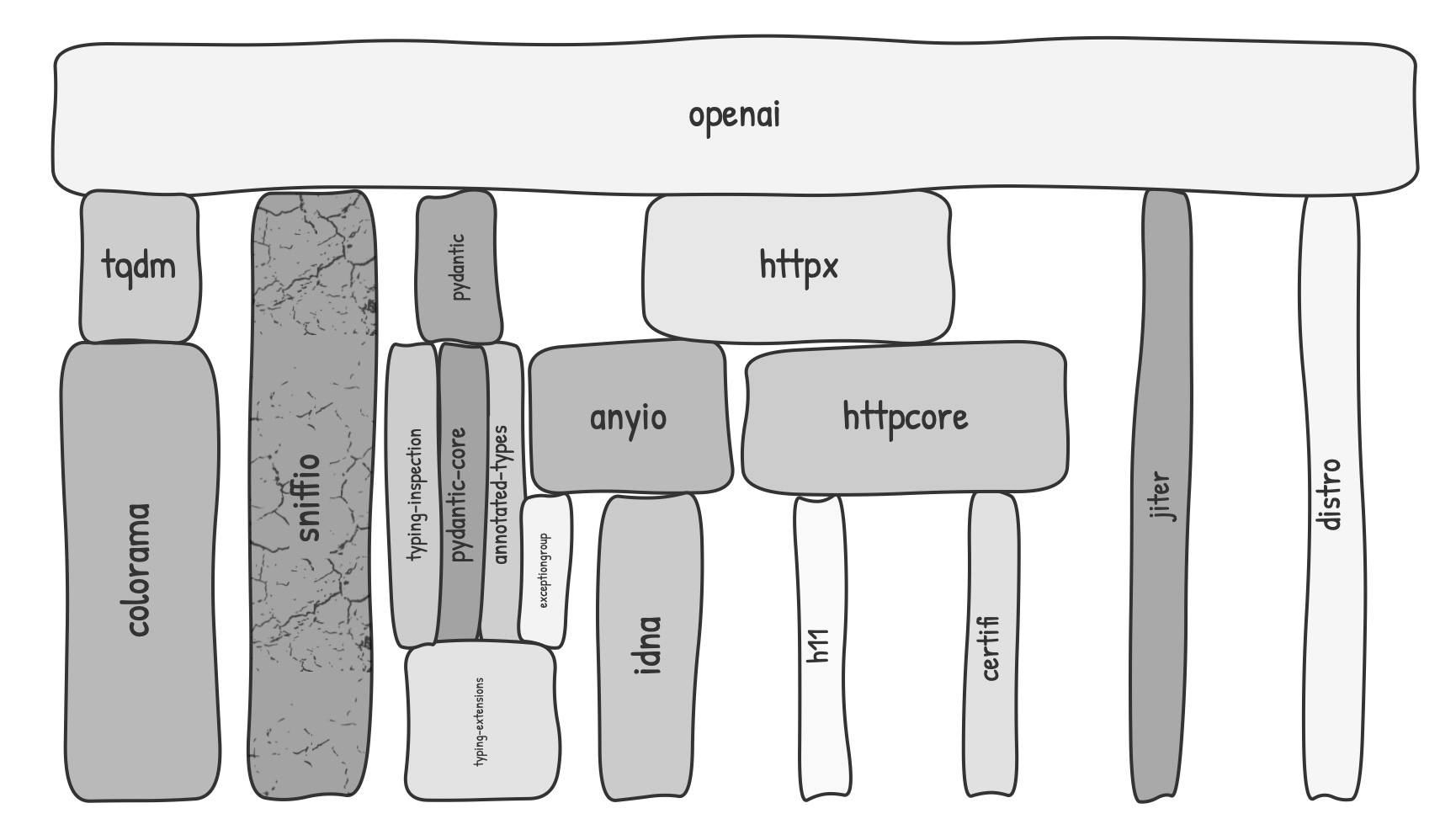
In a talk at Identiverse 2023 (reach out if you’d like the slides), I asked whether subsidiarity — the principle that power is best applied hyperlocally — can save decentralization. Trying to decentralize control often falls prey to insidious re-centralization. What helps is transparency, exposing dependencies, and making them measurable. This neat XKCD-style app does exactly that. See the image up top for an awesome sample.
“Staring at an NP-hard problem, the obvious move is to nope out. But NP-hard isn't hopeless; it just means there is no known shortcut for every case.”

The first “conference season” of 2026 is shaping up, and I’m excited to get going — visiting the RSA conference in San Francisco in March, EIC in Berlin in May, and much more. If you’re interested to have me join your event to speak on Mastering Digital Identity or other topics, please reach out!
Thanks, Eve. I’m particular interested in Children using and building AI. SPECIFICALLY around the security of agents created by students and growth through APIs, SIS/LMS and how it grows throughout school districts. One that the state of NJ is using a tool by Khan Academy called “Khanmigo” and a philanthropic accelerator (Newark,NJ +) through the Bill & Melinda Gates Foundation.